Neuroplasticity – How Your Brain Rewires Itself (Explained in Easy Words)
Neuroplasticity In a Nutshell
Neuroplasticity is your brain’s physical ability to change its structure and function throughout your life based on your experiences.
- Neuroplasticity = your brain’s ability to rewire itself based on what you do, think, or experience.
- It never fully stops, but it’s strongest in childhood and gradually slows with age.
- You can boost it through learning, movement, mindfulness, and challenge — not just “brain games.”
- It’s key for learning new skills, recovering from brain injury, and even improving mood.
- It can work for you (growth) or against you (bad habits, anxiety loops).
What Neuroplasticity Really Means
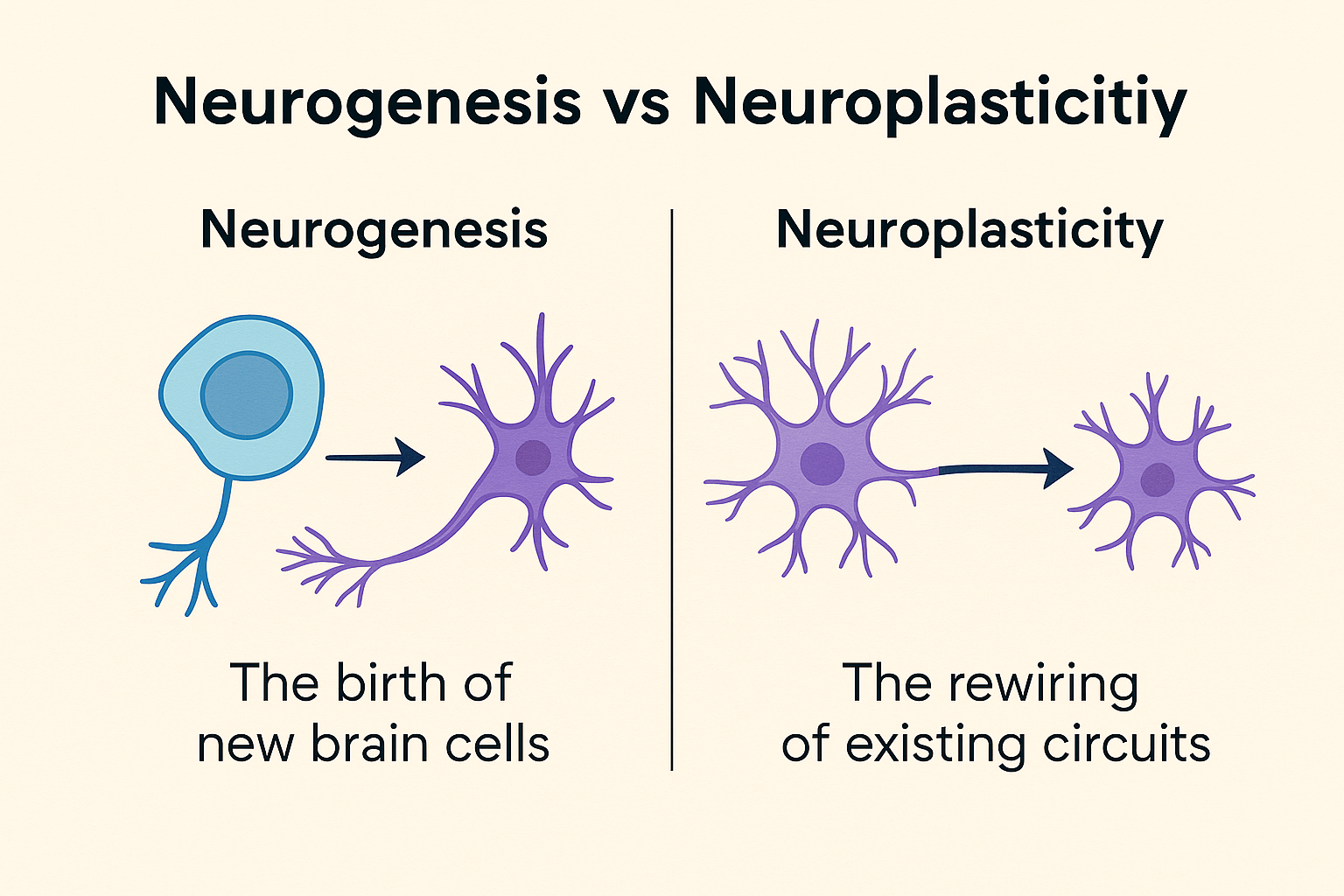
Neuroplasticity (or brain plasticity) is your brain’s ability to change its wiring. Instead of being a fixed machine, your brain is more like wet clay — constantly reshaped by what you practice, think about, and experience.
Every thought you think, every skill you practice, every experience you go through slightly changes the connections between your neurons (the brain’s “wiring”). Over time, the most-used connections get stronger (“use it and improve it”) and the unused ones fade (“use it or lose it”).
The Core Components (Breaking It Down)
To fully “get” neuroplasticity, it helps to see its main moving parts:
- Neurons: The brain cells that carry signals.
- Synapses: The tiny gaps where neurons talk to each other.
- Strengthening & Weakening: When you repeat an action, those synapses strengthen (like carving a deeper path). When you stop, they weaken.
- Structural Changes: New branches can grow (new learning) or shrink (forgetting).
- Chemical Changes: Your brain uses more or less neurotransmitters to make signaling faster or slower.
The Brain as a City (Analogy)
Think of your brain like a city. Neurons are the roads, synapses are the intersections.
- When you do something new, a new side road appears.
- Practice the skill? That road gets widened into a highway.
- Stop using it? Nature lets it crumble to save resources.
How Neuroplasticity Works (Step by Step)
- Trigger: Something happens — you learn a skill, have an experience, think a thought.
- Activation: Neurons fire together (“cells that fire together, wire together”).
- Strengthening: The connection between those neurons gets stronger — faster signaling next time.
- Structural Growth: Over time, neurons may literally grow new branches, forming new circuits.
- Pruning: Unused connections get trimmed away.
- It Becomes Effortless: What was once hard (playing a guitar chord, doing a math problem) now feels automatic — that’s your brain’s new highway in action.
When Neuroplasticity Is Strongest
- Childhood: Brain wiring is at its peak flexibility — kids can pick up languages and skills at lightning speed.
- Adulthood: Slows down but never stops. Learning, exercise, and novelty keep it alive.
- Older Age: Still possible, but you need deliberate practice and effort to drive change.
Can Neuroplasticity Be Increased?
Yes — you can make your brain more “plastic” by:
- Learning new, challenging skills: Music, languages, puzzles, coding.
- Physical exercise: Especially aerobic movement, which boosts blood flow and growth factors.
- Mindfulness & meditation: Reorganizes attention and emotional circuits.
- Sleep: Where the brain consolidates changes and strengthens new pathways.
Neuroplasticity in Action (Examples)
- Stroke Recovery: Patients re-learn to walk or speak by rewiring surviving brain circuits.
- Phobias & PTSD: Therapy gradually rewires fear responses.
- Skill Mastery: Musicians’ motor cortex literally grows denser in the fingers they use most.
- Bad Habits: The same principle builds addictive loops — neuroplasticity is neutral, it just reinforces whatever you repeat.
FAQs About Neuroplasticity
Are neuroplasticity and brain plasticity the same?
Yes — they are two names for the exact same concept.
Can neuroplasticity be negative?
Yes. Bad habits, addictions, chronic pain, and anxiety loops are examples of “negative plasticity.” The same mechanism that helps you learn piano can also make worry or pain signals more automatic.
Can it cure ADHD, OCD, dementia, Parkinson’s?
It’s not a magic cure, but it’s the mechanism behind most effective management strategies:
- OCD: CBT builds new neural pathways that compete with compulsive ones.
- Parkinson’s: Physical therapy uses repetition to help other brain areas compensate.
- Dementia/Alzheimer’s: Cognitive training can slow decline by strengthening alternative pathways.
So neuroplasticity doesn’t erase the disease, but it gives the brain a toolkit to adapt.
How long does it take to rewire the brain?
Depends on intensity and repetition — small changes can happen in weeks, major rewiring may take months or years.
Common Myths About Neuroplasticity
- ❌ Myth: Neuroplasticity only happens in childhood.
✅ Truth: It’s lifelong — just slower in adulthood. - ❌ Myth: You can “hack” neuroplasticity with one brain game or supplement.
✅ Truth: Real change requires consistent learning, movement, and practice. - ❌ Myth: Neuroplasticity is always good.
✅ Truth: It also cements bad habits, anxiety loops, and chronic pain if left unchecked.
How to Harness Your Brain’s Plasticity Starting Today
- Learn One New Thing: Commit to learning a skill — a language, an instrument, or even coding.
- Reframe a Habit: Pick a small bad habit and replace it with a positive action.
- Move Your Body: Even a brisk 20-minute walk boosts BDNF (brain fertilizer).
- Be Mindful: Five minutes of focused breathing trains attention circuits.
- Sleep Well: Aim for 7–8 hours to lock in learning and memory.
Key Takeaway
Neuroplasticity is not just a science buzzword — it’s the reason you can change, grow, and recover at any stage of life. But it’s also why bad habits are hard to break. Whatever you feed your brain, it wires itself to make that easier.
If you want a different brain, give it different experiences — and repeat them until they become your new default.
References:
- Shaffer, J. (2016). Neuroplasticity and Clinical Practice: Building Brain Power for Health. Frontiers in Psychology. https://www.frontiersin.org/articles/10.3389/fpsyg.2016.01118/full
- StatPearls. (2024). Neuroplasticity. NCBI Bookshelf. https://www.ncbi.nlm.nih.gov/books/NBK557811/