Burnout in Easy Words: Symptoms, Causes, Stages, Misconceptions, Recovery, and When to Get Help
It’s 9:30 p.m. on a random Tuesday. You’ve “finished” work three times already, then Slack pings again. You feel your chest tighten. You tell yourself you’ll catch up over the weekend.
The weekend comes. You sleep more. But you still wake up tired, and now you feel weirdly detached—like your brain is buffering.
Burnout is sometimes described as occupational exhaustion, work-related mental fatigue, or chronic work stress, but those labels often blur together and miss what’s actually happening.
Note: If you can’t take time off right now, skip to the No-Leave Plan and start there.
What Burnout Is (And Isn’t)
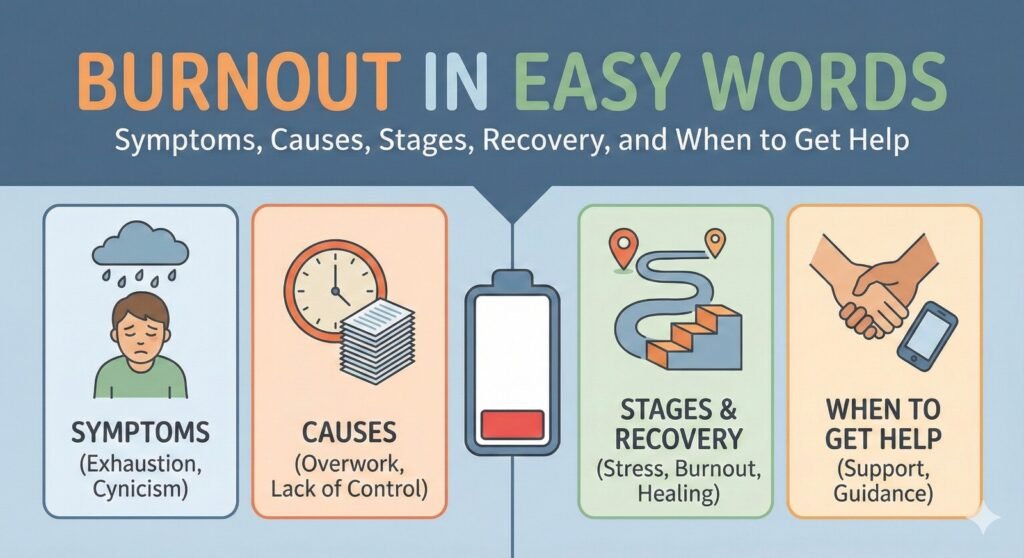
The World Health Organization (WHO) describes burnout as an occupational phenomenon resulting from chronic workplace stress that hasn’t been successfully managed. It involves three main changes:
- Exhaustion: Your energy is permanently depleted.
- Cynicism: You feel a growing mental distance or “bad attitude” toward your job.
- Inefficacy: You’re working, but you feel like you’re getting nothing done.
Burnout vs. Normal Tiredness
| Feature | Normal Fatigue | Burnout |
| Recovery | Better after 1–2 nights of good sleep. | Sleep doesn’t fix the “dread.” |
| Perspective | You’re tired but still care. | You feel cynical, numb, or detached. |
| Focus | Mostly intact. | Rereading the same email 5 times. |
Burnout Symptoms: What it Looks Like in Real Life
Burnout shows up in “buckets.” If you see yourself in several of these, your body is sending you a signal.
- Energy Problems: Tired most days, slow recovery, sleep that doesn’t feel restorative.
- Brain Fog: Worse focus, memory lapses, and simple decisions feel heavy.
- Mood Shifts: Irritability, emotional flatness, and a “leave me alone” mentality.
- Physical Stress: Headaches, jaw/neck tension, stomach issues, or getting sick more often.
- Behavior Drift: Procrastination that feels like “pain avoidance” and doomscrolling to escape.
The 30-Second Self-Check
If you answer “yes” to 3 or more, you’re likely in burnout territory:
- Rest doesn’t fully recharge me anymore.
- Work makes me more cynical or detached than I used to be.
- My output feels worse even when I try hard.
- My memory or decision-making has noticeably declined.
- My body is physically stressed (sleep issues, tension, headaches).
Causes of Burnout: The 6 Common Drivers
Burnout is often described as “too much work,” but that’s rarely the full story. Most people can handle hard periods if they feel some control, fairness, or meaning. Burnout develops when pressure stays high and the system never gets relief in the ways that matter.
Burnout isn’t just “too much work.” It’s usually a combination of these six factors:
Workload: When the math doesn’t work
This isn’t about having busy weeks. It’s about a workload that consistently exceeds the time and energy available. You can work efficiently, prioritize well, and still fall behind because the volume regenerates faster than you can clear it. When there is no realistic “done” state, your system never stands down. Rest helps you survive the next day, but it doesn’t fix a workload that is structurally too large.
Low Control: Responsibility without authority
You’re expected to deliver outcomes, but you don’t get to shape the process, timelines, or trade-offs. Decisions are made elsewhere, yet you’re accountable for the result. This creates constant background tension because effort alone can’t guarantee success. Burnout accelerates when people feel trapped inside systems they can’t adjust.
Reward Gap: Effort that stops paying back
The work keeps demanding more, but the return doesn’t grow with it. That return might be money, recognition, growth, or a sense that what you’re doing matters. When effort rises and payoff stays flat or shrinks, motivation erodes. This isn’t entitlement. It’s how humans assess whether sustained effort makes sense.
Broken Team: Friction that drains energy
Low trust, unclear ownership, poor communication, or quiet politics add strain that doesn’t show up on task lists. You spend energy protecting yourself, clarifying decisions after the fact, or redoing work that shouldn’t have needed rework. Even when the workload is reasonable, this constant friction keeps the system tense and alert.
Unfairness: Inconsistent rules and outcomes
Seeing others receive credit you earned, watching standards change depending on who’s involved, or feeling singled out forces people into constant vigilance. Unfair environments make work feel unsafe, even when no one is openly hostile. That ongoing alertness is exhausting over time.
Values Mismatch: Work that conflicts with who you are
You’re asked to support outcomes that clash with your ethics, priorities, or sense of usefulness. This can show up as selling something you don’t believe in, pushing metrics that feel dishonest, or contributing to work that feels pointless. Even manageable workloads become draining when the work itself feels wrong.
One thing people miss
Burnout rarely comes from just one of these. Many people can tolerate high workload with strong control. Others can handle low control if rewards feel fair. Burnout develops when multiple pressures stack and none of them release.
That’s why generic fixes fail. They treat the surface, not the structure.
The Stages of Burnout
Burnout doesn’t arrive all at once. It moves in steps. Most people don’t notice the early ones because things still “work.”
Stage 1: Overdrive
You’re still functioning and delivering, but it costs more effort than it used to. Longer hours and reduced recovery become normal, even though nothing has visibly failed yet.
Stage 2: Emotional Drag
Motivation drops before performance does. Tasks feel heavier, irritation increases, and you start feeling detached or cynical about work that used to feel manageable.
Stage 3: Cognitive Failure
Focus, memory, and decision-making become unreliable. Even simple tasks feel harder, and trying harder no longer restores clarity.
Stage 4: Detachment and Shutdown
Emotional disengagement sets in. Avoidance increases, productivity drops sharply, and rest provides limited relief because the underlying strain hasn’t changed.
If you want a deeper breakdown of how burnout unfolds and how the stages differ from one another, continue here: Stages of Burnout.
Common Misconceptions About Burnout
“If I were really burned out, I’d be exhausted all the time.”
Not true. In the early stages, energy can look fine. What drops first is tolerance. Small tasks feel heavier. Interruptions irritate you more than they used to. You’re not wiped out yet, but you’re burning extra fuel to stay functional.
“Burnout happens suddenly.”
It usually doesn’t. Most people slide through the early stages while telling themselves they’re just busy, just stressed, or just need to push a little longer. By the time things feel “serious,” the system has already been under strain for months.
“If I can still perform, I’m not burned out.”
Performance can stay intact long after burnout has started. Output often collapses late. The warning signs show up earlier in mood, motivation, and cognitive load, not in your resume metrics.
“Rest fixes burnout.”
Rest helps fatigue. Burnout is different. If demands stay high and control stays low, time off only brings partial relief. People often come back from a break feeling better for a week, then sink right back to where they were.
“Stage 4 means you’ve failed or broken.”
Stage 4 isn’t weakness. It’s your nervous system protecting itself when earlier warning signs were ignored or impossible to act on. Detachment is not a character flaw, It’s generally a shutdown response.
Most burnout advice fails because it treats everyone the same. Someone in early overdrive needs different changes than someone who’s already numb and avoiding work. Mixing those up leads to advice that feels useless or insulting.
The Recovery Plan: Phase by Phase
Phase 1: Stabilize (The first 48 hours)
Your nervous system needs to “downshift.”
- Action: Pick one thing to remove immediately. A non-essential meeting, a “nice-to-have” slide, or a self-imposed deadline.
- Goal: Create a tiny pocket of breathing room.
Phase 2: Reduce Demand (The next 7 days)
- Action: Run a “stress audit.” List your top 10 stressors. Mark the ones you can actually change.
- Goal: Identify your levers. Without levers, you’re just in endurance mode.
Phase 3: Rebuild (Weeks 2–4)
- Action: Protect your sleep timing. Move for 20 minutes a day (a walk counts).
- Goal: Restore cognitive function.
No-Leave Plan: When Time Off Isn’t an Option
If you can’t quit and you can’t take a vacation, use these damage control tactics:
- The “Minimum Viable Day”: Pick one meaningful task and one maintenance task. Do those first, then reassess.
- The Trade-Off Script: When a new task arrives, say: “I can deliver A by Friday. If you need B as well, tell me which one I should drop or delay.”
- Micro-Recovery: Take 10 minutes to walk without a phone. It sounds small, but it prevents the “wired and drained” loop.
- The Stop-Doing List: Actually write down 2 things you will stop doing or start doing “well enough” instead of perfectly.
When to Get Professional Help
Burnout can overlap with depression. Seek professional help if:
- The “heaviness” spreads to your life outside of work.
- You are using substances to cope.
- Urgent: If you have thoughts of self-harm or feel unsafe, call/text 988 (in the US) or visit Find A Helpline globally.
Burnout – In Easy Words
Burnout happens when stress keeps going and your body stops expecting relief. It’s not just being tired; it’s feeling drained, cynical, and ineffective. You fix it by reducing the load and increasing your control, not just by sleeping more.
Your next step: In the next 24 hours, send one “trade-off” message at work. Force a decision on what gets done and what gets dropped. Burnout shrinks when demands stop being infinite.