Preventing Burnout Relapse: How to Avoid Sliding Back After Recovery
Most burnout prevention advice is written for people who have never burned out. It assumes you still have normal tolerance, normal recovery, and room to “manage stress better.” If you’ve already burned out once, that advice often doesn’t work. Not because you’re doing it wrong, but because your system is different now.
After burnout, the goal isn’t to avoid stress entirely. It’s to avoid recreating the conditions that caused the collapse in the first place. That’s a different problem, and it requires different thinking.
This page is about preventing relapse. Not by becoming tougher, more disciplined, or more resilient — but by recognizing early warning signs and refusing to rebuild the same unsustainable setup that broke you.
(If burnout is still active, start with Burnout Treatment. Prevention only works once recovery has begun.)
Why “Burnout Prevention” Advice Usually Fails After Recovery
Most prevention advice focuses on surface behaviors: time management, self-care routines, positive thinking, better habits. Those things can help before burnout happens. After burnout, they’re often insufficient.
The reason is simple. Burnout isn’t caused by a lack of coping skills. It’s caused by prolonged strain combined with limited control and inadequate recovery. If those conditions return, relapse follows, regardless of how motivated or self-aware you are.
This is why people say things like “I did everything right and still burned out again.” They didn’t miss a trick. They rebuilt the same structure with better intentions.
Preventing relapse means identifying which parts of that structure cannot come back — even if everything else does.
What Actually Needs to Change to Prevent Relapse
Preventing burnout relapse isn’t about doing more things “right.” It’s about identifying which conditions cannot return, even if everything else does.
Most relapses happen because people focus on surface adjustments while the underlying structure quietly rebuilds itself. Hours creep back up. Availability expands again. Responsibility increases without matching control. Recovery gets postponed because “things are better now.”
The specifics vary, but relapse prevention almost always requires changes in three areas: how much load you carry, how much control you have over that load, and how reliably you recover from it. If any one of those slips back to its old pattern, burnout tends to follow.
This doesn’t mean work has to be easy. It means it can’t be endlessly extractive.
Early warning signs people ignore the second time
Relapse rarely starts with exhaustion. It starts with familiar patterns returning quietly.
Many people notice they’re working longer again, but tell themselves it’s temporary. Others feel emotional flattening or irritability and dismiss it as a rough patch. Cognitive strain often reappears subtly: slower thinking, more effort for routine tasks, shorter patience for complexity.
Another common sign is shortened recovery. Sleep or time off helps less than it did a few weeks ago, but not enough to trigger alarm. By the time symptoms feel obvious, the system has already been under strain again for a while.
Recognizing these early signals matters because relapse prevention works best before burnout fully reactivates.
(For how these symptoms show up in daily life, see What Burnout Feels Like.)
Preventing relapse when you can’t change everything
Not everyone can redesign their job, leave their role, or dramatically reduce workload. Relapse prevention doesn’t require perfect conditions. It requires enough difference.
When control is limited, the most important question becomes: which pressures matter most? Some stressors are tolerable. Others are not. Preventing relapse often means protecting a few critical boundaries even when everything else stays imperfect.
This might involve limiting simultaneous responsibilities, preserving non-negotiable recovery time, or refusing certain forms of constant availability. It’s less about balance and more about containment.
If you can’t remove all strain, preventing relapse means making sure strain no longer accumulates unchecked.
(If time off isn’t possible, see How to Get Over Burnout Without Taking a Break.)
Prevention Is Not the Same as Treatment
It’s important to draw this line clearly.
Treatment focuses on stopping damage and restoring function when burnout is active. Prevention focuses on not recreating the conditions that caused the damage after recovery has begun.
Trying to prevent burnout while still burned out often fails. The system doesn’t have enough capacity to maintain protective changes yet. That’s why prevention advice feels useless or overwhelming when symptoms are still strong.
Once recovery is underway, prevention becomes realistic — not because you’re stronger, but because recovery is finally working again.
The Point Most Advice Misses
Burnout relapse is rarely caused by a lack of awareness. Most people who burn out a second time saw it coming in hindsight.
Prevention works when you stop negotiating with the same warning signs. When something that broke you before starts returning, the answer isn’t “maybe I can handle it now.” It’s deciding, early, that this pattern is not allowed back.
Burnout prevention after recovery isn’t about becoming tougher. It’s about becoming less willing to rebuild what already failed.
This page answers one question: how to avoid sliding back after burnout recovery.
If burnout is still active, start with Burnout Treatment.
If you want to understand how stages affect risk and recovery, see Stages of Burnout.
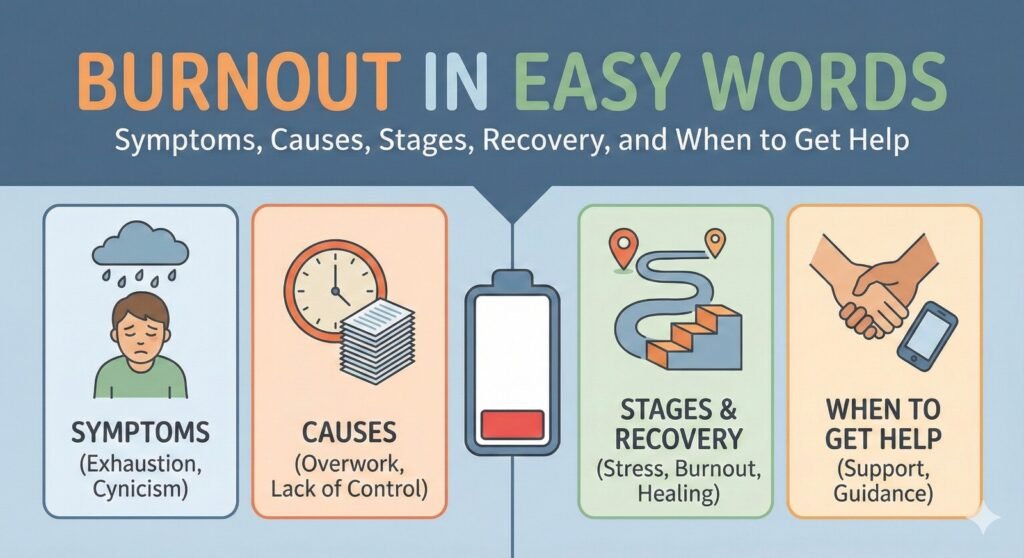
For the full context and definitions, return to Burnout in Easy Words.